
Ram Trucks Towing Guide: A Comprehensive Overview (Updated February 16, 2026)

Ram Trucks offer impressive towing capabilities, varying by model year and configuration; this guide details Ram 1500, 2500, and 3500 towing specs for informed decisions.
Ram Trucks have consistently earned a reputation for robust towing performance, making them a popular choice for individuals and professionals alike. Understanding these capabilities is crucial for safe and efficient hauling; This guide provides a comprehensive overview of Ram truck towing, covering various models – from the versatile Ram 1500 to the heavy-duty Ram 2500 and 3500.
Towing isn’t simply about brute strength; it involves a complex interplay of factors, including engine configuration, axle ratios, and vehicle weight. Ram engineers have meticulously designed these trucks to maximize towing capacity while maintaining control and stability. Whether you’re hauling a travel trailer, a boat, or heavy equipment, a Ram truck can be equipped to handle the task. This guide will help you navigate the specifics, ensuring you select the right truck and configuration for your needs, and operate it safely within its limits.
Understanding Towing Capacity Terminology
Successfully and safely towing with a Ram truck requires understanding key terminology. Towing capacity represents the maximum weight a vehicle can pull, as specified by the manufacturer. However, it’s not the only critical number. Payload capacity indicates the maximum weight the truck can carry within the vehicle bed, including passengers, cargo, and the tongue weight of the trailer.
Furthermore, Gross Vehicle Weight Rating (GVWR) is the maximum permissible weight of the fully loaded vehicle, while Gross Combined Weight Rating (GCWR) is the maximum allowable weight of the truck and the trailer combined. Exceeding these ratings can compromise vehicle handling and safety. Knowing these definitions is essential for calculating your vehicle’s actual towing capacity and ensuring you operate within safe and legal limits when utilizing your Ram truck’s capabilities.
Ram 1500 Towing Capacity: Model Year Variations
The Ram 1500’s towing capacity fluctuates significantly depending on the model year, engine, cab configuration, and axle ratio. Earlier models, like the 2020 Ram 1500, offered a range from approximately 6,390 pounds to a maximum of 12,750 pounds. These figures are influenced by choices like the engine – a V6 or V8 – and whether it’s a 4×2 or 4×4 configuration.
More recent models demonstrate improvements. Understanding these variations is crucial when researching a specific Ram 1500. Owners should consult their specific vehicle’s towing guide for accurate information. Factors like the presence of the Max Tow Package can substantially increase towing capabilities. Always prioritize referencing the official documentation for your particular truck’s specifications to ensure safe and legal towing practices.
2020 Ram 1500 Towing Specifications
The 2020 Ram 1500 presented a diverse range of towing capacities, largely dependent on configuration. With the 3.6L V6 engine and a 4×2 drivetrain, the base towing capacity started around 6,390 pounds. Upgrading to the 5.7L V8 engine significantly increased this, reaching up to 11,610 pounds with the standard setup.
However, equipping the 2020 Ram 1500 with the optional Max Tow Package boosted the maximum towing capacity to an impressive 12,750 pounds. This package included features like a heavy-duty cooling system and upgraded rear suspension. Payload capacities also varied, generally ranging from 1,800 to 2,300 pounds. Always verify the specific towing capacity based on your truck’s VIN and configuration details for accurate information.
2024 Ram 1500 Towing Specifications
The 2024 Ram 1500 continues to offer robust towing capabilities, building upon previous model years. Equipped with the 3.6L V6 engine, towing capacity generally ranges up to 7,700 pounds. However, the 5.7L HEMI V8 engine significantly elevates performance, achieving a maximum towing capacity of 12,750 pounds when properly equipped.
The 2024 model benefits from enhancements in suspension and technology, contributing to improved stability and control while towing. Payload capacities typically fall between 2,100 and 2,300 pounds, depending on configuration. Recent tests paired the Ram 1500 with camper trailers, demonstrating its real-world towing prowess. Refer to the official Ram documentation for precise specifications related to your specific vehicle build.
Ram 2500 Towing Capacity: Heavy-Duty Performance
The Ram 2500 is engineered for serious towing, stepping up from the 1500’s capabilities with a focus on heavy-duty tasks. This truck delivers substantial power and durability, making it ideal for hauling large trailers, boats, and equipment. For the 2024 model year, the Ram 2500 boasts a maximum towing capacity of up to 19,990 pounds when appropriately configured with the Cummins diesel engine and a fifth-wheel or gooseneck hitch.
Alongside impressive towing, the Ram 2500 offers a maximum payload capacity of 4,000 pounds. Real-world applications include towing 35-foot trailers with ease. A fifth-wheel or gooseneck hitch is required for loads exceeding 20,000 pounds, ensuring optimal weight distribution and control. Consult your specific truck’s documentation for precise figures.
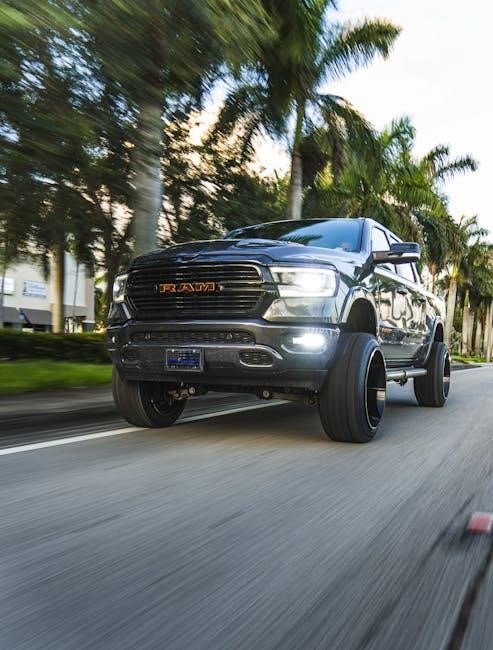
Maximum Towing Capacity of the Ram 2500 (2024)
The 2024 Ram 2500 achieves a remarkable maximum towing capacity of 19,990 pounds when properly equipped. This peak performance requires specific configurations, notably the 6.7L Cummins Turbo Diesel engine paired with a rear-wheel-drive (4×2) drivetrain. Utilizing a fifth-wheel or gooseneck hitch is essential to reach this maximum rating, providing superior stability and weight distribution for substantial loads.
It’s crucial to understand that this figure isn’t universally applicable across all Ram 2500 trims and configurations. Factors like cab style, bed length, axle ratio, and 4×4 capability all influence the final towing capacity. Always refer to your vehicle’s specific towing guide and door jamb sticker for the precise maximum towing capacity tailored to your truck. Proper configuration is key to safe and effective towing.
Payload Capacity of the Ram 2500 (2024)
Alongside its impressive towing capabilities, the 2024 Ram 2500 boasts a substantial payload capacity, reaching a maximum of 4,000 pounds. Payload refers to the total weight of passengers, cargo, and any accessories added to the truck bed. This capacity allows for hauling heavy materials, equipment, or substantial loads without exceeding the truck’s weight limits.
Similar to towing, the Ram 2500’s payload capacity varies based on configuration. Engine choice, cab style (Regular, Crew, or Mega Cab), bed length, and drivetrain (4×2 or 4×4) all play a role. Lower trims generally offer higher payload capacities due to reduced weight from fewer features. Always consult your vehicle’s door jamb sticker and owner’s manual to determine the precise payload capacity for your specific Ram 2500 model, ensuring safe and legal operation.
Ram 3500 Towing Capacity: The Ultimate Towing Machine
The Ram 3500 stands as Ram’s ultimate towing solution, engineered for the most demanding tasks. This heavy-duty pickup achieves a maximum towing capacity exceeding 19,990 pounds when properly equipped, making it ideal for hauling large trailers, heavy machinery, and substantial loads. This capability is largely due to its robust frame, powerful engine options, and available heavy-duty suspension components.
To achieve this maximum towing capacity, a 5th-wheel or gooseneck hitch is typically required for trailers exceeding 20,000 pounds. The Ram 3500 offers various configurations to optimize towing performance, including different axle ratios and engine choices. Careful consideration of these options, alongside payload capacity, is crucial for safe and efficient towing. Always refer to the official Ram towing guide for precise specifications related to your specific vehicle configuration.
Factors Affecting Ram Truck Towing Capacity
Several key factors influence a Ram truck’s maximum towing capacity. Engine configuration plays a significant role; more powerful engines generally allow for higher towing limits. The choice between gasoline and diesel engines directly impacts capability. Furthermore, cab and bed configuration also matters, as heavier cabs and longer beds can reduce overall payload and, consequently, towing capacity.

Axle ratio is another critical element, with lower ratios often preferred for towing due to increased torque. Additionally, options like 4×2 versus 4×4 drive systems affect towing numbers. It’s vital to remember that these factors interact; a powerful engine paired with a lighter configuration will yield the best results. Always consult your vehicle’s specific towing guide to understand how these elements combine to determine its precise towing limits.
Engine Configuration and Towing
Ram truck engine choices significantly impact towing capacity. Generally, larger displacement engines and those producing more torque enable higher towing numbers. For instance, a Ram 1500 equipped with the available 5.7L HEMI V8 will typically tow considerably more than a model with the base V6 engine. Diesel engines, like the 6.7L Cummins in Ram 2500 and 3500 models, are renowned for their exceptional towing prowess due to their substantial torque output at lower RPMs.
The engine’s ability to manage heat and maintain power under load is also crucial. Modern Ram engines incorporate features like enhanced cooling systems to support sustained towing. Selecting the appropriate engine for your intended towing needs is paramount; heavier loads demand the power and durability of a larger engine, ensuring both safety and performance.

Cab and Bed Configuration Impact
The cab and bed configuration of your Ram truck subtly influences its towing capacity. Crew Cab models, while offering more passenger space, often have a slightly lower towing capacity compared to Regular Cab configurations due to increased weight. This weight difference, though often minimal, affects the overall Gross Combined Weight Rating (GCWR).
Bed length also plays a role. Longer beds generally contribute to a slightly higher payload capacity, indirectly supporting heavier towing scenarios by allowing for better weight distribution. However, the primary impact stems from the vehicle’s overall weight. Choosing a configuration that balances passenger needs, cargo space, and towing requirements is essential. Always consult your specific truck’s towing guide for precise figures related to your chosen cab and bed combination.
Towing with Different Hitch Types
Selecting the correct hitch is crucial for safe and effective towing with your Ram truck. Bumper Hitch Towing is standard for lighter loads, typically under 10,000 pounds, offering convenience and ease of use. However, for heavier trailers, especially with Ram 2500 and 3500 models, a more robust solution is necessary.
5th Wheel and Gooseneck Hitch Towing provide superior stability and weight distribution. These hitches, mounted in the truck bed, are essential for trailers exceeding 20,000 pounds. They require a specialized setup but significantly enhance control and safety. Remember, a 5th-wheel or gooseneck hitch is required for heavier loads on Ram 2500/3500 trucks. Always verify hitch compatibility with your truck and trailer specifications.
Bumper Hitch Towing
Bumper hitch towing represents the most common and accessible method for hauling trailers with your Ram truck, particularly suitable for lighter-duty tasks. This system utilizes a receiver hitch mounted to the vehicle’s frame, accepting a ball mount to connect to the trailer coupler. It’s ideal for recreational trailers, smaller boats, and utility trailers generally weighing under 10,000 pounds.
Proper weight distribution is paramount when using a bumper hitch. Ensure the trailer tongue weight falls within the recommended range (typically 10-15% of the total trailer weight) to maintain vehicle stability. Regularly inspect the hitch receiver, ball mount, and coupler for wear or damage. Always utilize appropriate safety chains and a wiring harness for lights and brakes, adhering to all local towing regulations for safe operation.

5th Wheel and Gooseneck Hitch Towing (Ram 2500/3500)
Ram 2500 and 3500 trucks excel with 5th wheel and gooseneck hitch towing, designed for substantial loads exceeding 20,000 pounds. These systems offer superior stability and weight distribution compared to bumper hitching, crucial for heavy-duty applications. A 5th wheel utilizes a horseshoe-shaped hitch in the truck bed, while a gooseneck employs a ball-mounted hitch.
These hitches require specific truck bed configurations and professional installation. They are commonly used for large travel trailers, horse trailers, and heavy equipment transport. Always verify your Ram’s GCWR and payload capacity before towing. Proper setup, including correct kingpin weight and secure connections, is vital for safe towing. Remember that a 5th-wheel or gooseneck hitch is required for trailers over 20,000 lbs.
Calculating Your Vehicle’s Actual Towing Capacity
Determining your Ram truck’s actual towing capacity requires more than just referencing the manufacturer’s maximum figures. Several factors reduce the advertised capacity, including vehicle configuration, cargo weight, and added accessories. Start with the doorjamb sticker displaying your truck’s GVWR and GCWR. Subtract the vehicle’s weight (with passengers and cargo) from the GVWR to find available payload.
This payload capacity is then used to calculate the maximum trailer weight. Remember to account for tongue weight (typically 10-15% of trailer weight), which counts against the payload. Exceeding these limits compromises safety and vehicle performance. Consulting your owner’s manual and utilizing online towing guides specific to your Ram model are essential steps for accurate calculation.
Gross Vehicle Weight Rating (GVWR) Explained
The Gross Vehicle Weight Rating (GVWR) represents the maximum permissible weight of your Ram truck when fully loaded. This includes the vehicle’s own weight, passengers, fuel, cargo in the cab and bed, and the tongue weight of any trailer being towed. It’s a critical figure found on the vehicle’s doorjamb sticker and in the owner’s manual.
Exceeding the GVWR is dangerous and illegal, potentially damaging the vehicle’s suspension, brakes, and tires, while also compromising handling and safety. Understanding GVWR is crucial for calculating your truck’s payload capacity – the maximum weight you can add to the vehicle. Always prioritize staying within the GVWR to ensure safe and reliable operation of your Ram truck;
Gross Combined Weight Rating (GCWR) Explained
The Gross Combined Weight Rating (GCWR) defines the maximum allowable weight of your Ram truck plus a fully loaded trailer. Unlike GVWR, which focuses on the truck itself, GCWR considers the entire combined weight of both vehicles. This crucial specification is also located on the vehicle’s doorjamb sticker and within the owner’s manual.

Calculating GCWR involves adding the truck’s GVWR to the total weight of the loaded trailer. Exceeding the GCWR can severely strain the drivetrain, brakes, and overall vehicle stability, creating a hazardous driving situation. It’s vital to understand that GCWR is often lower than simply adding the maximum towing capacity to the GVWR, so always consult your truck’s specific rating for safe towing practices.
Towing Safety Features in Ram Trucks
Ram trucks are equipped with advanced safety features designed to enhance towing confidence and control. The Trailer Sway Control System actively detects and mitigates trailer sway by applying the brakes to individual wheels, helping maintain a stable trajectory. This system works seamlessly to counteract external forces like wind gusts or uneven road surfaces.
Furthermore, Electronic Stability Control (ESC) is standard, providing enhanced stability during emergency maneuvers and challenging driving conditions. ESC works in conjunction with the Trailer Sway Control, optimizing braking and engine power to help the driver maintain control. These integrated systems contribute significantly to a safer towing experience, providing peace of mind on every journey.
Trailer Sway Control System
The Trailer Sway Control System is a crucial safety feature in Ram trucks designed for towing. It continuously monitors the vehicle’s stability and detects potential trailer sway situations. When sway is detected, the system automatically applies the brakes to specific wheels on either side of the vehicle.

This selective braking creates a counter-torque, helping to straighten the trailer and bring it back into alignment with the truck. The system operates independently of the driver, intervening quickly and effectively to mitigate sway before it escalates into a dangerous situation. It’s a proactive safety measure, enhancing stability and control, especially when encountering wind gusts or uneven road conditions while towing.
Electronic Stability Control (ESC)
Electronic Stability Control (ESC) is a standard safety feature in all Ram trucks, playing a vital role in maintaining control during towing. Unlike Trailer Sway Control which focuses specifically on trailer movement, ESC monitors the vehicle’s direction and compares it to the driver’s intended path.
If ESC detects a discrepancy – indicating a potential skid or loss of control – it selectively applies brakes to individual wheels and can even reduce engine power. This corrective action helps steer the vehicle back onto the driver’s intended course. When towing, ESC works in conjunction with other systems to provide enhanced stability, particularly during emergency maneuvers or on slippery surfaces. It’s a foundational safety net for all driving conditions, becoming even more critical when hauling substantial loads.
Real-World Towing Scenarios for Ram Trucks
Ram trucks excel in diverse towing situations, catering to various needs. The Ram 1500 is frequently used for recreational towing, comfortably handling a 25-foot travel trailer weighing around 7,500 pounds, a 21-foot boat at 5,500 pounds, or a UTV on a utility trailer reaching 4,000 pounds. These scenarios demonstrate its versatility for weekend adventures and hobbies.
Stepping up to the Ram 2500/3500 unlocks heavy-duty capabilities. These trucks are ideal for hauling larger loads like 35-foot campers, substantial construction equipment, or livestock trailers. Owners often utilize them for professional applications, including transporting machinery, materials, and commercial goods. The robust design and increased towing capacity of these models make them indispensable for demanding tasks, showcasing Ram’s commitment to power and reliability.
Ram 1500: Common Towing Applications
The Ram 1500 shines in everyday towing tasks, proving incredibly versatile for a wide range of users. Many owners regularly tow travel trailers, typically ranging from 21 to 25 feet in length and weighing between 5,500 and 7,500 pounds, perfect for family vacations and weekend getaways. Boat owners frequently utilize the Ram 1500 to transport vessels up to 21 feet long, around 5,500 pounds, to enjoy watersports and fishing.

Beyond recreation, the Ram 1500 is also practical for hauling utility trailers carrying ATVs, UTVs, or landscaping materials, often weighing around 4,000 pounds. Its capabilities extend to smaller campers and equipment for home improvement projects, making it a valuable asset for both work and leisure, demonstrating its broad appeal and functionality.
Ram 2500/3500: Heavy-Duty Towing Examples
The Ram 2500 and 3500 truly excel in demanding towing scenarios, designed for those needing substantial hauling power. Owners frequently tow larger travel trailers, often exceeding 35 feet in length, requiring the robust capabilities of these heavy-duty trucks. These trailers can easily weigh upwards of 15,000 pounds, demanding a strong chassis and powerful engine.
For those in trades or with significant hauling needs, these Rams are ideal for transporting heavy equipment, construction materials, and livestock. Gooseneck and fifth-wheel hitches become essential when exceeding 20,000 pounds, unlocking the full potential of the Ram 3500. These trucks confidently handle substantial loads, making them indispensable for professional and demanding applications, showcasing their unwavering strength.
Resources for Determining Your Ram Truck’s Towing Capacity
Accurately determining your Ram truck’s towing capacity is crucial for safe and efficient hauling. The most reliable source is your vehicle’s official owner’s manual, providing specific figures based on your truck’s configuration. Ram also provides dedicated towing guides, often available for download on their official website, offering detailed charts and explanations.
Online resources, such as dedicated Ram truck forums and automotive websites specializing in towing, can offer valuable insights and user experiences. However, always cross-reference this information with official Ram documentation. Dealerships can also assist, providing access to towing guides and interpreting the specifications for your specific vehicle. Remember to consider all factors – engine, axle ratio, and cab configuration – for a precise calculation.
Where to Find Your Specific Ram Truck’s Towing Guide
Locating your Ram truck’s specific towing guide is straightforward. Begin by visiting the official Ram Trucks website; navigate to the “Owners” section and input your vehicle’s VIN (Vehicle Identification Number). This will direct you to resources tailored to your exact model year and configuration, including downloadable towing guides in PDF format.
Alternatively, your local Ram dealership can provide a physical copy of the towing guide. Many dealerships also offer digital access through their service departments. Online Ram truck forums often host archived towing guides for older models. Remember that guides are model-year specific, so ensure you’re referencing the correct one for your vehicle. These guides contain vital information regarding maximum towing and payload capacities, hitch requirements, and safety recommendations.