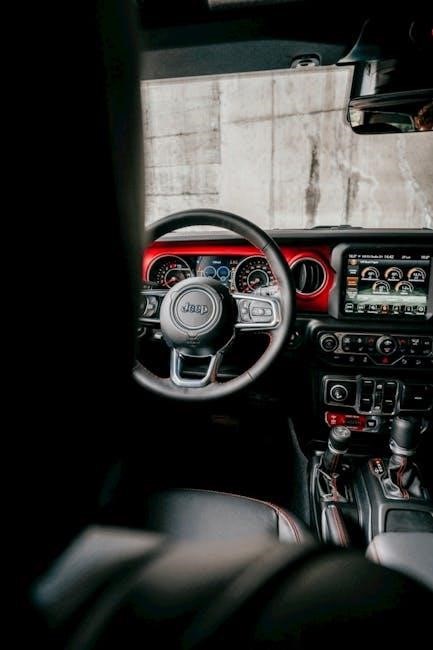
Understanding Manual Mode in Jeep Grand Cherokee
To disengage manual mode, simply shift the gear selector back into the Drive position when stationary, restoring automatic shifting functionality.
Alternatively, hold the right paddle shifter for two seconds to revert to automatic mode, or tap the console shifter (2016 models).
What is Manual Mode and Why Does it Activate?
Manual mode in the Jeep Grand Cherokee allows drivers to control gear selection using paddle shifters or the console shifter, overriding the automatic transmission’s decisions. Activation can occur through intentional paddle shifter use, or sometimes unexpectedly.
The system might engage if the paddle shifters are accidentally contacted during turns while accelerating. A P2706 code indicates a shift issue, potentially linked to TCM problems. Understanding this activation is key to quickly disengaging it by shifting to Drive or utilizing the paddles.
Identifying When Manual Mode is Engaged
The transmission display might show a manually selected gear (like 1st). Shifting behavior changes, potentially holding gears longer, indicating manual mode is active.
The Display Indicator
A key sign of manual mode engagement is the vehicle’s display. Owners have reported that the display will explicitly show the transmission being manually shifted into a specific gear, such as first. This visual cue immediately confirms that the automatic shifting has been overridden.
Pay close attention to the gear indicator; if it doesn’t show ‘D’ (Drive), you’re likely in manual control. Recognizing this indicator is crucial for promptly disengaging the mode and returning to standard operation.
Shifting Behavior Changes
When in manual mode, the Jeep Grand Cherokee’s shifting characteristics noticeably alter. Acceleration while turning may result in the transmission not upshifting, even when expected, unless utilizing the paddle shifters for manual gear selection.
Smooth, automatic upshifts during straight-line acceleration are typical, but this changes with cornering. This altered behavior signals manual control, prompting a return to ‘Drive’ or paddle shifter disengagement for normal operation.
Methods to Disengage Manual Mode
Disengage manual mode by shifting to ‘Drive’ when stopped, holding the right paddle shifter for two seconds, or tapping the console shifter (2016 models).
Shifting to Drive
A primary method to exit manual mode involves returning the gear selector to the ‘Drive’ position. Ensure the vehicle is completely stationary before attempting this maneuver for optimal results. This action typically restores the transmission to its fully automatic shifting behavior, allowing the Jeep to manage gear changes independently.
However, be aware that in certain Grand Cherokee models, simply shifting to ‘Drive’ might not immediately disengage manual mode. You may need to repeat the process or combine it with another method, like using the paddle shifters, to fully revert to automatic operation.
Using the Paddle Shifters
A convenient way to disable manual mode is by utilizing the paddle shifters themselves. Specifically, holding the right paddle shifter for approximately two seconds will reliably switch the transmission back to automatic shifting. This method provides a quick and direct way to regain full control from the vehicle’s computer.
This technique bypasses the need to manipulate the gear selector, offering a seamless transition during driving. Remember this simple hold-and-release action for effortless disengagement of manual control.
Console Shifter Technique (2016 Models)
For owners of 2016 Jeep Grand Cherokee models, a specific console shifter technique can disengage manual mode. Tapping the console shifter to the left into the /- position is reported to return the transmission to automatic operation. This method offers an alternative to using the paddle shifters or shifting to Drive.
It’s a quick maneuver, but ensure a firm, deliberate tap for successful disengagement. This technique is unique to this model year, providing a dedicated way to exit manual control.
Troubleshooting Persistent Manual Mode
If manual mode persists, consider a software update or transmission reset. A P2706 code may indicate deeper transmission issues requiring professional diagnosis and repair.
Software Updates and Resets
Dealerships can often resolve persistent manual mode issues through comprehensive software updates, addressing potential glitches within the transmission control module (TCM). These updates reportedly cover nearly all software components, including a full transmission reset to factory settings.
This process aims to eliminate any programming errors causing unintended manual mode engagement. If updates fail, a complete transmission reset might be necessary, effectively “relearning” the transmission’s shift patterns and potentially resolving the problem. However, this is best performed by a qualified technician.
P2706 Code and Transmission Issues
The P2706 code frequently appears alongside reports of unintended manual mode activation in Jeep Grand Cherokees. This code indicates an issue with the transmission’s internal electronic controls, often manifesting as the system believing the transmission is manually shifted to first gear.
Addressing this code often requires more than simply disengaging manual mode; it necessitates diagnosing and repairing the underlying transmission problem, potentially involving sensor replacements or TCM recalibration.
Disabling Paddle Shifters Permanently
You can permanently disable the paddle shifters through the vehicle’s settings menu, preventing accidental activation of manual mode and ensuring automatic shifting.
Accessing Vehicle Settings
To access the settings for disabling paddle shifters, navigate through the Jeep Grand Cherokee’s Uconnect infotainment system. Typically, this involves entering the “Vehicle Settings” menu, often represented by a gear icon. Within this menu, locate options related to drivetrain or performance features.
Look for a specific setting labeled “Paddle Shifter Control” or similar, allowing you to toggle the functionality on or off. Remember that the exact menu structure can vary slightly depending on the model year and trim level of your Grand Cherokee. Once disabled, the paddle shifters will no longer activate manual mode.
Paddle Shifter Deactivation Options
The Jeep Grand Cherokee offers a straightforward method to deactivate paddle shifters through the vehicle’s settings. Within the Uconnect system, locate the “Paddle Shifter Control” option, usually found under “Vehicle Settings” or “Drivetrain.” Selecting this option presents a simple toggle to disable paddle functionality.
Disabling the paddles prevents accidental manual mode engagement. You can easily re-enable them at any time by returning to the settings menu and toggling the control back on, providing flexibility based on your driving preferences and conditions.
Situational Use of Manual Mode
Manual mode is ideal for off-roading, allowing controlled gear selection while crawling, preventing unwanted shifts during challenging terrain navigation.
Off-Roading and Trail Scenarios
When navigating difficult trails, utilizing manual mode provides crucial control over gear selection, preventing automatic upshifts that could disrupt momentum or compromise traction.
Locking the transmission into first or second gear, as some owners do, maintains consistent power delivery during crawling, avoiding unintended shifts when momentarily stopping;
This deliberate control is vital, as automatic shifting could hinder progress and diminish the Jeep’s off-road capabilities, ensuring a more confident and capable experience.
Controlled Gear Selection
Manual mode empowers drivers to dictate precise gear choices, optimizing engine braking during descents or maintaining optimal RPMs for challenging ascents.
Unlike automatic mode, which relies on algorithms, manual control allows for immediate responses to terrain changes, ensuring consistent power and preventing unwanted gear hunting.
This level of control is particularly beneficial when towing or hauling, enabling drivers to maintain a steady speed and avoid strain on the transmission, enhancing overall performance.
Potential Causes of Unintended Manual Mode Activation
Accidental contact with the paddle shifters is a common cause, as is a potential issue within the Transmission Control Module (TCM) itself.
Accidental Paddle Shifter Contact
The Jeep Grand Cherokee’s paddle shifters are conveniently located, but susceptible to unintentional activation; even a brief touch can engage manual mode.
Drivers report the system activating during normal driving, particularly while turning and accelerating, leading to unexpected gear holding.
Awareness of the paddle shifter’s position is crucial, and utilizing the vehicle’s settings to disable them offers a preventative solution against inadvertent engagement.
Remember to shift back to Drive or hold the right paddle to disengage.
Transmission Control Module (TCM) Issues
Persistent manual mode engagement, even after attempting disengagement methods, can indicate a deeper problem within the Transmission Control Module (TCM).
A malfunctioning TCM might incorrectly interpret signals or fail to release manual control, resulting in the P2706 code and continued manual shifting.
Software updates and complete transmission resets are often attempted to rectify TCM-related issues, sometimes requiring multiple attempts to resolve the problem effectively.
Professional diagnosis is crucial for TCM concerns.
PCM Reprogramming for Specific Models (2018 3.0L V6)
For the 2018 3.0L V6, PCM reprogramming addresses powertrain control issues potentially causing unintended manual mode activation and related transmission problems.
Addressing Powertrain Control Issues
Software updates and a complete PCM reprogramming, including a transmission reset to factory settings, are often employed to resolve persistent manual mode engagement. These procedures aim to correct underlying powertrain control module (TCM) malfunctions that might be falsely triggering manual shifting.
Specifically, addressing the P2706 code—indicating a manually shifted gear—through reprogramming can restore normal automatic operation. This comprehensive approach ensures all software components work harmoniously, preventing unintended activation of manual mode while driving in ‘D’.
Safety Considerations
For airbag system service, always refer to the manufacturer’s service repair manual or Mitchell’s Airbag Service and Repair Manual for proper procedures.
Airbag System Service Procedures
When performing any service that involves potential airbag deployment, strict adherence to manufacturer guidelines is paramount for technician and vehicle safety. Specifically, always consult the official Jeep Grand Cherokee service repair manual or Mitchell’s Airbag Service and Repair Manual before commencing work.
These resources detail critical steps for safely disabling and enabling the airbag system, preventing accidental activation during procedures unrelated to manual mode. Ignoring these protocols could result in serious injury.
Referencing Service Manuals
Detailed troubleshooting for persistent manual mode issues, including the P2706 code, necessitates consulting the official Jeep Grand Cherokee service manual. These manuals provide comprehensive diagnostic flowcharts and repair procedures beyond simply shifting to Drive or using paddle shifters.
They outline specific software update procedures and reset protocols, crucial for addressing TCM or PCM malfunctions potentially causing unintended manual mode engagement. Always prioritize factory-recommended methods.
Model-Specific Variations
Disengagement methods vary; 2016 models may require tapping the console shifter, while newer models prioritize Drive selection or paddle shifter holds.
2024 392 Model Observations
Owners of the 2024 Jeep Grand Cherokee 392 report intermittent, unintended manual mode activation even while driving in ‘D’. Despite not utilizing the paddle shifters, the transmission occasionally engages manual control.
To resolve this, shifting firmly back into Drive is generally effective, though sometimes requires a second attempt. Furthermore, the vehicle settings offer an option to permanently disable the paddle shifters, preventing accidental engagement of manual mode altogether, providing a more consistent driving experience.
Differences Across Grand Cherokee Generations
Disengaging manual mode varies across Grand Cherokee generations. Newer models (like 2024) often require a deliberate shift back to ‘D’, potentially needing repetition. Older models, particularly 2016 versions, can be switched off by tapping the console shifter to the left into the /- position.
Holding the right paddle shifter for two seconds consistently works across many years. Software updates and PCM reprogramming can also influence how easily manual mode disengages, depending on the specific vehicle.
Resetting the Transmission
A full transmission reset, often performed during software updates, can resolve persistent manual mode issues, returning the system to factory default settings.
Returning to Factory Settings
Resetting the transmission to factory settings is a more comprehensive solution for stubborn manual mode problems, often undertaken during extensive software updates by dealerships.
This process essentially clears the transmission’s learned data and restores it to its original programmed state, potentially resolving issues where the system incorrectly engages or remains in manual mode.
While a simple shift to Drive or paddle shifter hold often suffices, a full reset addresses deeper software glitches, ensuring proper automatic operation is restored. It’s a significant step, usually requiring specialized diagnostic tools.
Understanding Gear Selector Behavior
After utilizing manual mode, consistently shift back to the Drive position when stopped to reliably disengage it and resume automatic transmission control.
Shifting Back to Drive After Use
Following engagement of manual mode via paddle shifters or console interaction, returning to automatic operation is generally straightforward. When your Jeep Grand Cherokee comes to a complete stop, deliberately shift the gear selector firmly back into the Drive position. This action should disengage manual control, allowing the transmission to resume its automated shifting patterns.
However, be aware that in certain Grand Cherokee models, a simple shift to Drive might not immediately deactivate manual mode. If this occurs, repeating the process or utilizing the paddle shifter hold-down method is recommended for complete disengagement.
Community Forums and Resources
Jeep Grand Cherokee owners groups online discuss this issue frequently, offering solutions like shifting to Drive or paddle shifter resets for manual mode.
Jeep Grand Cherokee Owners Groups
Online Jeep Grand Cherokee forums, such as the Jeep Cherokee Owners group with nearly 5,000 members, are invaluable resources. Owners share experiences regarding unintended manual mode activation and solutions.
Many report success by simply shifting back into Drive, while others detail using the paddle shifters to reset the system. Discussions also cover the P2706 code and potential software updates needed to resolve persistent issues. These communities provide practical advice and support for fellow Jeep enthusiasts facing similar challenges.

Preventative Measures
Be mindful of accidental paddle shifter contact, as even a brief touch can activate manual mode. Awareness of their location is crucial for avoiding unintended shifts.
Awareness of Paddle Shifter Location
The paddle shifters, positioned conveniently behind the steering wheel, are easily bumped during normal driving maneuvers, potentially activating manual mode unintentionally. Drivers should develop a heightened awareness of their hand positioning and proximity to these shifters.
Regularly checking the display indicator is vital to confirm automatic mode engagement. If manual mode activates unexpectedly, immediately shift to Drive or utilize the paddle shifter hold-down method to regain full automatic control, preventing unwanted gear selections.
When to Seek Professional Help
If manual mode persists despite attempts to disengage, or the P2706 code appears, consult a qualified technician for a thorough transmission diagnosis and repair.
Diagnosing Complex Transmission Problems
Persistent manual mode issues, even after shifting to Drive or utilizing paddle shifter resets, often indicate deeper transmission control module (TCM) concerns. A professional diagnostic scan can reveal underlying problems.
The P2706 code frequently points to transmission issues requiring software updates or, in severe cases, TCM replacement. Reprogramming the powertrain control module (PCM) may also be necessary, particularly for 2018 3.0L V6 models. Technicians will assess for internal transmission faults and ensure proper communication between all related systems.