Algebra 1 Study Guide: A Comprehensive Plan
This guide provides a structured approach to mastering Algebra 1, covering foundational concepts, equations, inequalities, functions, and polynomials for academic success.
Algebra 1 marks a pivotal shift in mathematical thinking, moving beyond arithmetic to embrace abstract concepts and symbolic reasoning. This course builds upon pre-algebra foundations, introducing variables to represent unknown quantities and utilizing expressions to define relationships. Students will learn to manipulate these expressions, solve equations, and interpret functions – skills crucial for higher-level mathematics and real-world problem-solving.
Essentially, algebra is about discovering ‘missing numbers’ and establishing general rules, offering a powerful toolkit for analyzing patterns and making predictions. It’s a puzzle-solving adventure!
Foundational Concepts: Review of Pre-Algebra
A strong grasp of pre-algebra is essential for success in Algebra 1. This includes a solid understanding of arithmetic operations – addition, subtraction, multiplication, and division – with whole numbers, integers, and rational numbers. Reviewing concepts like order of operations (PEMDAS/BODMAS) is vital.
Furthermore, familiarity with fractions (adding, subtracting, multiplying, and dividing) and exponents is crucial. Understanding verbal expressions and translating them into mathematical statements forms a key building block for algebraic thinking. These foundational skills provide the necessary base for tackling more complex algebraic concepts.
Exponents and Radicals Review
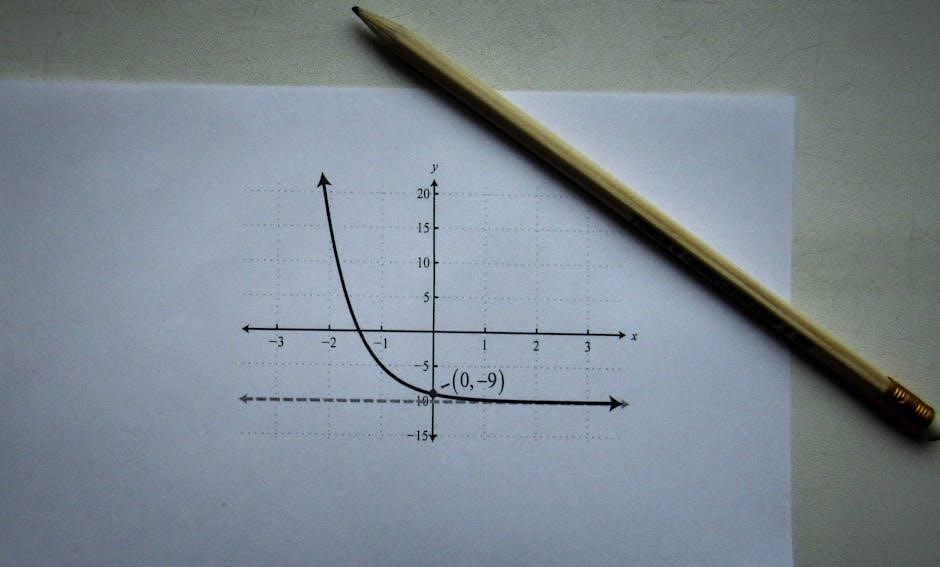
Exponents represent repeated multiplication, and mastering exponent rules is fundamental. Review the product rule (xm * xn = xm+n), quotient rule (xm / xn = xm-n), power of a power rule ((xm)n = xmn), and zero exponent rule (x0 = 1).
Radicals are the inverse of exponents, representing roots. Simplify radicals by finding perfect square factors. Understand the relationship between exponents and radicals (x1/2 = √x). Practice converting between exponential and radical forms to solidify your understanding of these interconnected concepts.
Fraction Operations Review (Addition, Subtraction, Multiplication)
A strong foundation in fraction operations is crucial for Algebra 1. Remember to find a common denominator before adding or subtracting fractions: (a/c) + (b/c) = (a+b)/c and (a/c) ー (b/c) = (a-b)/c. Multiplication is straightforward: (a/b) * (c/d) = (ac)/(bd).
Division involves multiplying by the reciprocal: (a/b) / (c/d) = (a/b) * (d/c). Always simplify your answers to lowest terms. Practice these operations with both proper and improper fractions to build confidence.
Expressions and Variables
In Algebra 1, you’ll work extensively with expressions – combinations of numbers, variables, and operations. Variables are symbols (usually letters) representing unknown values. For example, in the expression 3x + 5, ‘x’ is the variable. Understanding this distinction is fundamental.
Algebra isn’t about finding specific numbers, but about relationships between numbers represented by these variables. We manipulate expressions to solve for these unknowns, essentially solving puzzles using mathematical rules.
Parts of an Expression: Terms, Coefficients, Constants
An algebraic expression is built from terms, separated by addition or subtraction. A term can be a number, a variable, or a product of both. For instance, in ‘5x + 3y ⎻ 7’, each part (‘5x’, ‘3y’, and ‘-7’) is a term;
The coefficient is the number multiplying a variable (e.g., ‘5’ in ‘5x’). A constant is a term with just a number, having a fixed value (e.g., ‘-7’). Identifying these parts is crucial for simplifying and solving equations.
Evaluating Algebraic Expressions
Evaluating an algebraic expression means finding its numerical value by substituting given values for the variables. Follow the order of operations (PEMDAS/BODMAS) – Parentheses/Brackets, Exponents/Orders, Multiplication and Division (from left to right), Addition and Subtraction (from left to right).
For example, if ‘x = 2’ and the expression is ‘3x + 5’, substitute ‘2’ for ‘x’: 3(2) + 5 = 6 + 5 = 11. Carefully replace each variable with its assigned value and simplify to obtain the final result.
Solving Linear Equations
Solving linear equations involves isolating the variable (usually ‘x’) on one side of the equation. Utilize inverse operations – addition/subtraction, multiplication/division – to maintain balance. The goal is to manipulate the equation until the variable stands alone, revealing its value.
Remember, whatever operation is performed on one side must be performed on the other to preserve equality. For instance, to undo addition, subtract; to undo multiplication, divide. Always check your solution by substituting it back into the original equation.
One-Step Equations
One-step equations require a single operation to isolate the variable. These equations present a foundational skill for algebraic manipulation. If an equation states ‘x + 5 = 12’, subtract 5 from both sides to find x = 7. Conversely, if ‘3x = 21’, divide both sides by 3, resulting in x = 7.
The key is to perform the inverse operation to ‘undo’ what’s being done to the variable, always maintaining balance on both sides of the equals sign. Practice these diligently to build confidence!

Two-Step Equations
Two-step equations build upon one-step equations, requiring two operations to isolate the variable. Begin by addressing addition or subtraction, then tackle multiplication or division. For example, consider ‘2x + 3 = 9’. First, subtract 3 from both sides: ‘2x = 6’. Then, divide both sides by 2 to get ‘x = 3’.
Remember the order of operations in reverse – undo addition/subtraction before undoing multiplication/division. Consistent practice is crucial for mastering this essential algebraic skill and building a strong foundation.
Multi-Step Equations
Multi-step equations demand a strategic approach, combining the techniques from one and two-step equations. The key is to simplify by applying the order of operations in reverse. Distribute, combine like terms, and then isolate the variable using addition, subtraction, multiplication, or division.
For instance, solving ‘3(x + 2) ⎻ 5 = 16’ requires distribution (3x + 6 ⎻ 5 = 16), combining like terms (3x + 1 = 16), and finally, isolating ‘x’ through subtraction and division. Careful organization prevents errors!
Linear Inequalities
Linear inequalities share similarities with equations, but instead of an equals sign (=), they use inequality symbols: <, >, ≤, or ≥. Solving them involves isolating the variable, much like equations, but a crucial difference arises when multiplying or dividing by a negative number.
This action reverses the inequality sign. For example, solving -2x < 8 requires dividing by -2, which flips the sign to x > -4. Understanding this rule is vital. Representing solutions often involves a number line, showcasing all values satisfying the inequality.
Solving and Graphing Linear Inequalities
Solving linear inequalities mirrors solving equations, employing inverse operations to isolate the variable; However, remember the critical rule: multiplying or dividing both sides by a negative number flips the inequality sign. For instance, -3x ≥ 12 becomes x ≤ -4 after division.
Graphing the solution involves drawing a number line. Use an open circle for < or > (exclusive) and a closed circle for ≤ or ≥ (inclusive). Shade the line representing all solutions satisfying the inequality, visually demonstrating the solution set.
Compound Inequalities
Compound inequalities combine two separate inequalities with “and” or “or.” “And” requires solutions satisfying both inequalities – the solution is the intersection of the individual solution sets. Graphically, this means shading the region where both inequalities overlap on the number line.
“Or” requires solutions satisfying either inequality – the solution is the union of the individual solution sets. On a graph, shade all areas covered by either inequality. Careful attention to open and closed circles is crucial for accurate representation.
Equations and Inequalities with Fractions
Solving equations and inequalities containing fractions requires finding a common denominator to eliminate them. Multiply every term on both sides of the equation/inequality by this common denominator. This crucial step clears the fractions, transforming the problem into a standard linear equation or inequality.
Remember to check for extraneous solutions, especially with inequalities, as multiplying by a negative number reverses the inequality sign. Careful simplification and adherence to order of operations are key to success.
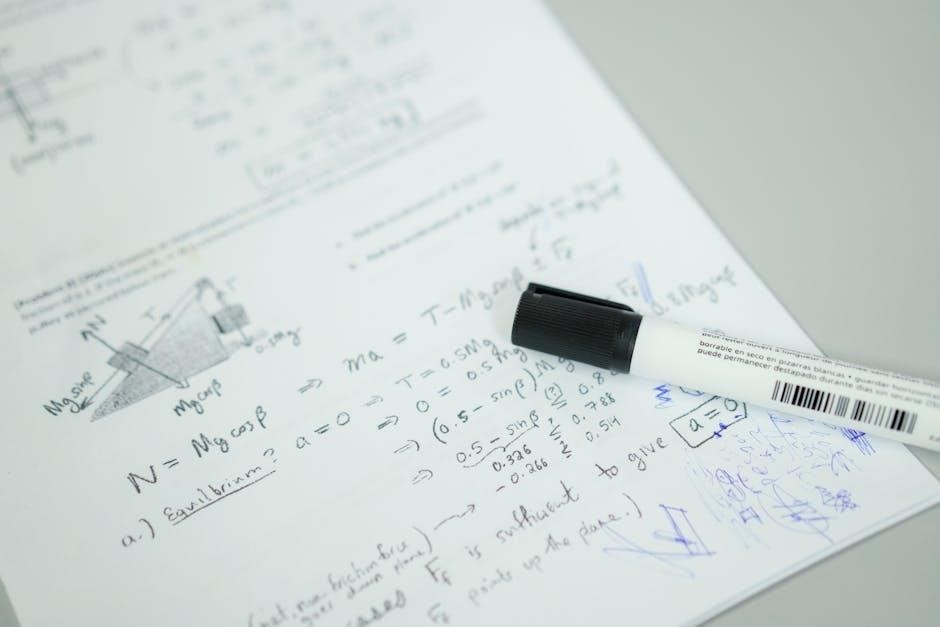
Functions represent relationships where each input yields a single output. We often denote this as f(x) = y, where ‘x’ is the input and ‘y’ is the output. Understanding functions is crucial as they model real-world scenarios and are foundational for higher-level math.
Key concepts include the domain (possible input values) and range (possible output values). Functions can be represented as equations, graphs, or tables, each offering a different perspective on the relationship between variables.

Graphing Linear Equations and Inequalities
Visualizing linear equations and inequalities on a coordinate plane is essential. For equations (like y = mx + b), graphing involves plotting points or using slope-intercept form. The slope (m) indicates steepness, and the y-intercept (b) shows where the line crosses the y-axis.
Inequalities (like y > mx + b) are graphed similarly, but with a dashed line to indicate values are not included, and shading to represent the solution set. Understanding these graphical representations builds a strong conceptual foundation.
Systems of Equations and Inequalities
Solving systems involves finding the point(s) where two or more equations are true simultaneously. Methods include graphing (finding intersection points), substitution, and elimination. Graphing reveals the solution visually, while algebraic methods provide precise coordinates.
Systems of inequalities involve finding the region where all inequalities are satisfied. This is represented by overlapping shaded areas on a graph. Mastering these techniques is crucial for modeling real-world scenarios with multiple constraints.
Polynomials and Factoring
Polynomials are expressions with terms involving variables raised to non-negative integer powers. Basic operations include addition, subtraction, and multiplication – combining like terms is key. Factoring is the reverse of multiplication, breaking down a polynomial into simpler components.
Techniques include finding the Greatest Common Factor (GCF) and recognizing patterns like the Difference of Squares. Factoring simplifies expressions and helps solve polynomial equations, revealing roots and understanding polynomial behavior.
Basic Polynomial Operations (Addition, Subtraction)
Performing addition and subtraction with polynomials involves combining ‘like terms’ – those with the same variable and exponent. Distribute negative signs carefully when subtracting. Remember to maintain the polynomial’s structure by organizing terms by descending degree.
Simplifying these expressions is a foundational skill for more complex polynomial manipulations. Accuracy is crucial; double-check your work to avoid errors in combining coefficients and exponents. Mastering this builds confidence for future algebraic tasks.
Factoring Techniques (Greatest Common Factor, Difference of Squares)
Factoring is reversing the distributive property. Begin by identifying the Greatest Common Factor (GCF) within a polynomial and factor it out. Next, recognize and apply the Difference of Squares pattern: a² ⎻ b² = (a + b)(a ー b).
These techniques simplify expressions and are essential for solving quadratic equations later. Practice identifying these patterns quickly. Remember, factoring isn’t just about finding answers; it’s about understanding the structure of polynomials and manipulating them effectively.
Radicals and Rational Expressions
Radicals involve finding roots of numbers (like square roots). Simplify radicals by factoring out perfect squares. Remember that √(a * b) = √a * √b. Rational Expressions are fractions with polynomials. Simplifying these involves factoring both the numerator and denominator to cancel common factors.
Operations like addition and subtraction require a common denominator, similar to regular fractions. Mastering these concepts builds a strong foundation for more advanced algebraic manipulations and problem-solving.
Simplifying Radicals

Simplifying radicals means expressing them in their most basic form. This involves identifying the largest perfect square factor within the radicand (the number under the radical symbol). For example, √12 can be simplified to 2√3 because 4 is the largest perfect square that divides 12.
Remember to extract the square root of the perfect square factor. This process ensures the radical is in its simplest form, making further calculations easier and more accurate. Practice is key to mastering this skill!
Word Problems: Translating to Algebraic Equations
Translating word problems into algebraic equations is a crucial skill in Algebra 1. Begin by carefully identifying the unknown quantities and assigning variables to represent them. Next, dissect the problem to pinpoint the relationships between these unknowns.
Keywords like “sum,” “difference,” “product,” and “quotient” signal specific mathematical operations. Convert these relationships into equations, then solve for the unknown variable. Practice consistently to build confidence and accuracy in problem-solving!

Exponent Laws and Notation
Understanding exponent laws is fundamental to simplifying algebraic expressions. Key laws include the product rule (xm * xn = xm+n), quotient rule (xm / xn = xm-n), power of a power ( (xm)n = xm*n), and zero exponent (x0 = 1).
Mastering these rules allows efficient manipulation of exponential terms. Pay close attention to negative exponents (x-n = 1/xn) and fractional exponents (x1/n = n√x). Consistent practice solidifies comprehension and application.
Algebra: Definition and Applications
Algebra is a branch of mathematics utilizing symbols to represent numbers and quantities in formulas and equations. Unlike arithmetic focusing on specific values, algebra deals with abstract concepts and generalized rules. It’s a powerful tool for problem-solving across diverse fields.
Applications span science, engineering, economics, and computer science. Algebra enables modeling real-world scenarios, predicting outcomes, and analyzing relationships. From calculating distances to designing structures, its principles are universally applicable, making it a crucial skill.
Final Review and Practice
Comprehensive review is key! Revisit all core concepts: linear equations, inequalities, functions, polynomials, and radicals. Utilize practice tests and quizzes to assess your understanding and identify areas needing improvement. Focus on translating word problems into algebraic expressions – a crucial skill.
Work through a variety of problems, increasing in complexity. Don’t just memorize steps; understand the why behind each operation. Consistent practice builds confidence and solidifies your algebraic foundation, preparing you for future math courses.
Frequently Asked Questions (FAQs) about Algebra 1
Q: What’s the core focus of Algebra 1? A: It builds upon arithmetic, introducing variables and expressions to solve equations and inequalities. It’s a gateway to higher-level math!
Q: Is Algebra 1 hard? A: It can be challenging, but with consistent practice and a solid understanding of foundational concepts, success is achievable. Don’t hesitate to seek help!
Q: Why is algebra important? A: It develops problem-solving skills applicable to science, engineering, and everyday life. It’s a fundamental tool for logical thinking;